
Asbestos in an Older Home: Where Is It Really Hiding, Room by Room?
You’ve just bought a 1960s bungalow in Laval or a duplex in Rosemont, and renovations are set to begin soon. The inspector wrote “possible presence of asbestos” in the report, without specifying where. The question isn’t whether your older home contains asbestos — it’s which materials it’s hiding in. In a house built before 1990, asbestos can be found in about a dozen common materials, from the basement all the way up to the attic, and it only becomes dangerous once it’s disturbed.
Why Asbestos in an Older Home Is a Problem
Asbestos is a mineral fiber that was once added to hundreds of building products for its resistance to fire and heat. According to Quebec’s workplace health and safety board (CNESST), a material is considered to contain asbestos once its concentration reaches 0.1%. As long as the material stays intact — sealed inside a wall or under a floor — it doesn’t release fibers. The risk appears when it’s sawed, drilled, sanded, torn out, or scraped: microscopic fibers become airborne, get inhaled, and the diseases they cause (asbestosis, lung cancer, mesothelioma) show up 15 to 30 years later. That’s why unplanned renovation work in a pre-1990 home is often riskier than the house itself. And if work begins without any testing, the contractor can rightfully halt the job — which delays everything and drives up the bill.
What Quebec Actually Requires
No law requires a homeowner to remove asbestos from a house they live in. The obligation kicks in once renovation work starts. Quebec’s Safety Code for Construction Work (CQLR, c. S-2.1, r. 4) requires every contractor to check for asbestos before undertaking work likely to release fibers, through laboratory analysis of representative samples. Unless proven otherwise, several materials are presumed to contain asbestos based on their installation date:
- Gypsum board and joint compound manufactured in North America before January 1, 1980
- Spray-applied coatings (fireproofing sprayed onto ceilings or structural elements) installed before February 15, 1990
- Pipe and boiler insulation installed before May 20, 1999
These rules exist primarily to protect workers. A homeowner doing their own renovations isn’t bound by them, but they’re breathing the same fibers. Since 2018, the federal government has banned the manufacture, import, and use of asbestos in Canada — but materials already in place remain in homes across the country. Finally, asbestos debris can’t go in a regular dumpster: it must be bagged and transported to an authorized disposal site, according to your municipality’s rules.
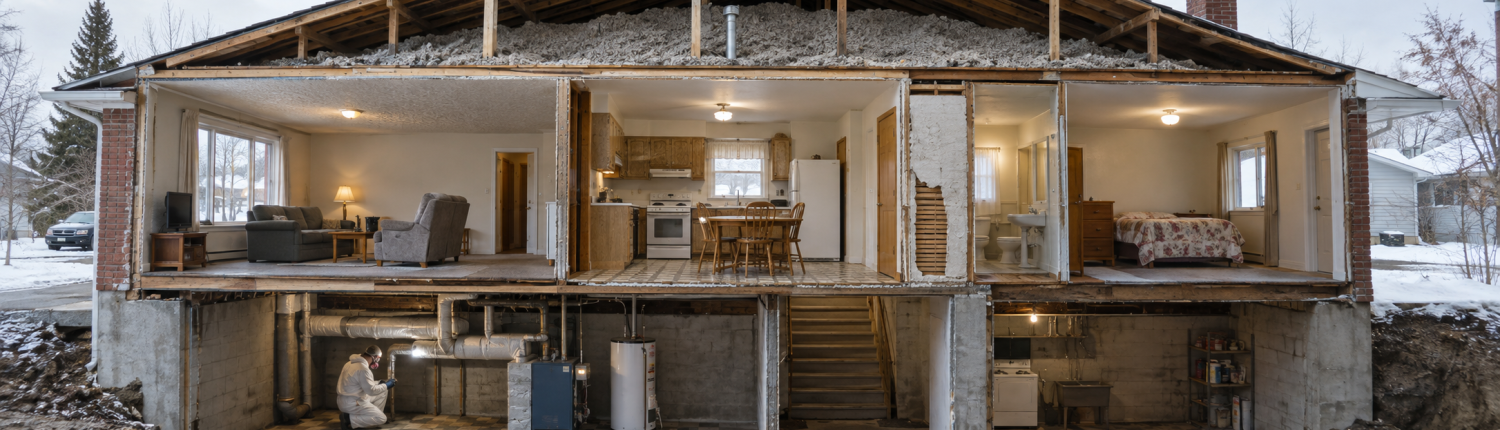
Where Asbestos Hides, Room by Room
CNESST’s list includes about a dozen families of materials. Here’s how they’re typically distributed in a Montreal or South Shore home built between 1930 and 1990.
In the Basement: Pipes, Furnace, and Flooring
This is the most heavily affected room. The white or grayish insulation wrapped around heating pipes and the old furnace is typically the material richest in asbestos in an older home. If it’s crumbling or pieces are lying on the floor, don’t touch it. On the floor, 9-by-9-inch vinyl floor tiles and the black adhesive holding them down often contain asbestos as well.
In the Kitchen and Bathroom
Here, asbestos is found underfoot and in the walls. Sheet vinyl flooring often sits on an asbestos-containing paper backing — tearing it up is exactly the move to avoid. Plaster walls, pre-1980 joint compound, and certain fiber-cement panels behind the stove round out the picture.
In the Living Room and Bedrooms
Textured ceilings — often called stucco, or “popcorn” ceilings — are the usual suspects. Plaster in homes built before the 1960s and joint compound in homes built before 1980 can also contain asbestos. Scraping a textured ceiling to modernize it is one of the most common renovation jobs — and one of the riskiest.
In the Attic
If you see loose-fill insulation made of small, shiny gold or silver granules, that’s vermiculite. Some of the vermiculite sold in Canada, notably under the Zonolite brand, contains asbestos. Don’t move it, don’t store anything in it, and don’t run cables through it before having it tested.
Outdoors
Asphalt shingles, roofing felt, fiber-cement siding and soffits, and certain buried fiber-cement pipes are also on the list. Any demolition involving these materials needs to be carefully planned.
Your Options: Leave It, Encapsulate It, or Remove It
Finding asbestos doesn’t mean tearing everything out. A material that’s intact and out of reach can be left in place — its presence simply gets noted for future work and for resale. A material that’s intact but exposed, like a textured ceiling, can be encapsulated under a sealant or a new surface, as long as it will never be drilled or pierced afterward. Removal becomes necessary when the material is damaged, when planned work will disturb it, or when a buyer, insurer, or lender requires it. This assessment — done before any recommendation — is what prevents paying for unnecessary abatement, or, just as bad, renovating over a real problem.
The Process, Step by Step
It all starts with sampling: material samples are sent to a recognized laboratory, which confirms the presence and type of asbestos. AIRE D3 Inc. then reviews the report with you and proposes a solution suited to your project and your budget. On the day of the job, the work area is sealed off under plastic sheeting and placed under negative pressure; materials are wetted down and then removed by properly equipped workers, and the debris is bagged and transported to an authorized disposal site. A HEPA vacuum cleanup and a final inspection close out the file, along with the report you’ll need for your contractor, insurer, or buyer. You don’t have to coordinate the lab, the transport, and the disposal yourself.
Take Action
Planning to renovate, sell, or refinance an older home in Montreal, Laval, the South Shore, or the North Shore? Start by having the at-risk materials identified. AIRE D3 Inc. is a family business founded in 2011, with 20 years of experience in the field and more than 5,000 completed projects. We handle asbestos removal from start to finish: assessment, containment, removal, compliant disposal, and a final report. Our work is covered by a Régie du bâtiment du Québec (RBQ) license and $2,000,000 in pollution liability insurance. You get a recommendation tailored to your project — not the most expensive one. Call us at 514 900 3366 or request a quote.
Frequently Asked Questions
My house was built in 1975 — does it definitely contain asbestos? Very likely, in at least one material. Joint compound, vinyl tiles, pipe insulation, and textured ceilings from that era commonly contained asbestos. Only a laboratory analysis can confirm it, material by material.
How much does an asbestos test cost? A single sample analysis typically costs a few dozen dollars at the lab. The total cost depends on how many materials need to be checked. It’s a modest expense compared to a stalled job site or emergency abatement.
Can I remove asbestos-containing vinyl tiles myself? It’s not recommended. The tiles themselves stay relatively low-risk if removed whole, but the adhesive and paper backing release fibers as soon as they’re scraped. Without containment or a HEPA vacuum, fibers spread throughout the entire house.
Do I have to disclose asbestos when I sell my home? Yes, if you’re aware of its presence. A known but undisclosed presence of asbestos can be grounds for a hidden-defect claim from the buyer. An analysis report and, where applicable, a removal certificate reassure the buyer and protect the seller.
Can we stay in the house during removal? Often, yes — if the work area is properly contained. For a basement or attic job, the family can usually stay in the rest of the house. For ceiling work in living areas, moving out for a few days is sometimes the simpler option.
